Why Legacy Data Conversion Matters for Modern Businesses
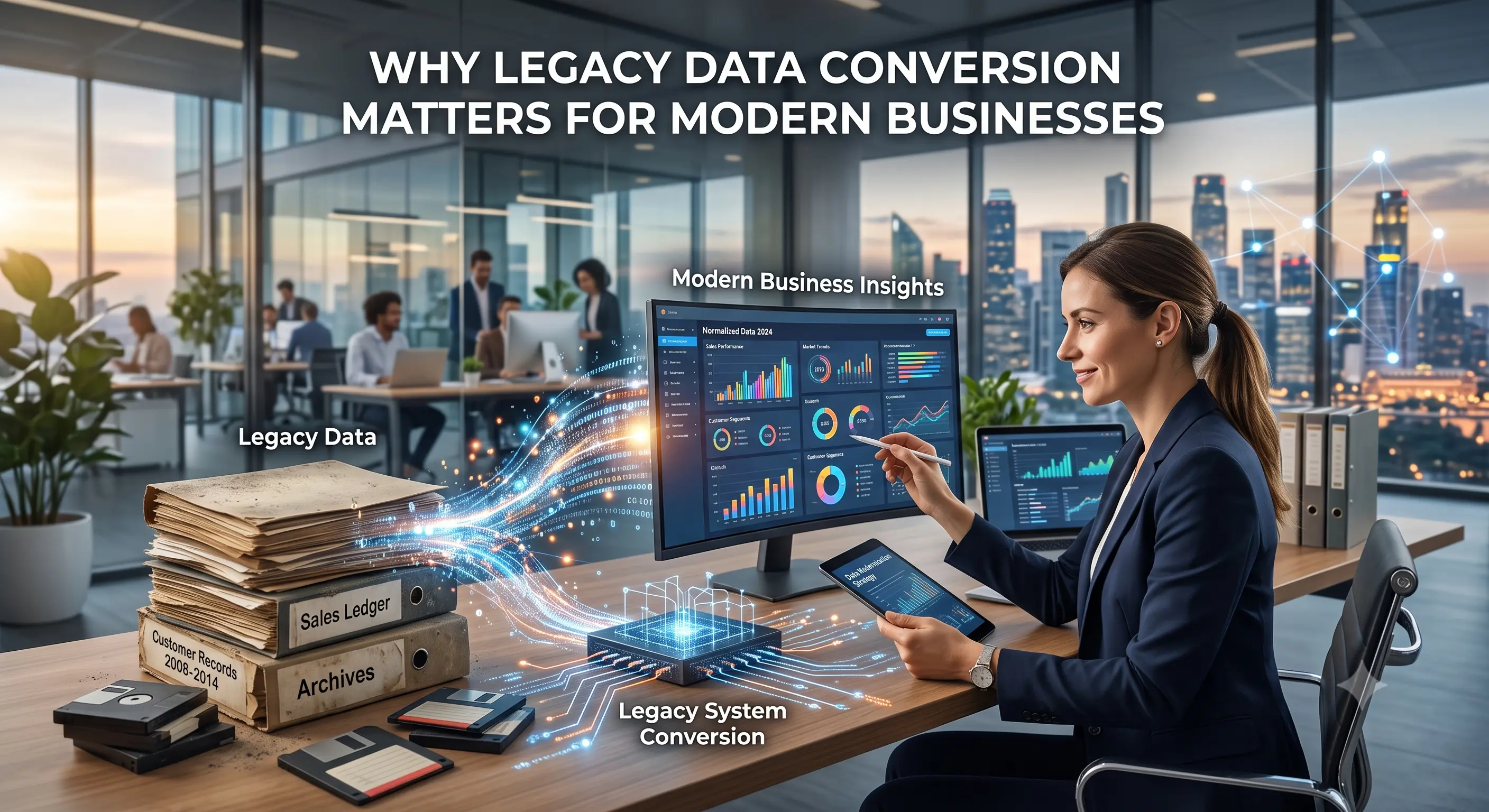
For many organizations, legacy data represents years or even decades of valuable business knowledge. Customer records, financial transactions, operational reports, contracts, inventory history, and compliance documents often remain stored in outdated systems or file formats that are difficult to access and integrate. Legacy data conversion transforms this information into clean, structured, and standardized datasets that modern applications can use efficiently. Rather than being a simple technical task, data conversion plays a vital role in digital transformation, operational efficiency, regulatory compliance, and business decision-making.
Need help extracting valuable business records trapped inside legacy documents?
Historical PDFs, scanned documents, reports, and spreadsheets contain information your business depends on—but it's difficult to search and even harder to analyze. We convert legacy documents into accurate, database-ready datasets, making your data instantly searchable, easier to manage, and ready for modern business applications.
Legacy systems still contain valuable information
Many businesses continue to rely on historical information that was created long before modern cloud platforms and enterprise applications existed. Financial statements, customer databases, engineering documents, invoices, payroll records, and archived reports often remain stored inside legacy software, PDFs, spreadsheets, text files, or proprietary databases. Although these systems may be outdated, the information they contain continues to support business operations, compliance requirements, and long-term decision making.
Supports digital transformation initiatives
Organizations investing in digital transformation often replace aging applications with modern ERP, CRM, cloud, and analytics platforms. However, these new systems are only as effective as the data they receive. Legacy data conversion ensures historical information is accurately transformed into formats compatible with modern software, enabling organizations to modernize without losing valuable business knowledge.
Better decision making
Reliable business decisions depend on reliable data. When records are standardized, validated, and stored in a consistent structure, reporting becomes significantly faster and more accurate. Executives can compare historical trends, monitor performance across departments, and generate business intelligence without spending valuable time correcting inconsistent data. High-quality converted data improves confidence in reports and supports better strategic planning.
Improves operational efficiency
Employees often waste hours searching through multiple documents, manually entering information, or correcting formatting inconsistencies inherited from legacy systems. Converting historical data into structured databases eliminates many of these repetitive tasks. Teams gain faster access to information, automated workflows become possible, and business processes become more efficient across departments.
Reduced business risk
- Minimizes errors caused by outdated layouts and manual data entry.
- Protects valuable historical records before legacy systems are retired.
- Improves audit readiness with validated and traceable datasets.
- Supports ERP, CRM, and database migration projects with clean source data.
- Reduces duplicate records and inconsistent business information.
- Preserves historical information during software modernization projects.
- Helps prevent costly migration failures caused by poor data quality.
Strengthens regulatory compliance
Many industries must retain historical business records for years to satisfy legal, financial, and regulatory requirements. Converting legacy data into structured, searchable formats makes compliance activities significantly easier. Auditors can quickly locate required information, organizations can generate reports more efficiently, and businesses reduce the risk of losing critical records as legacy software becomes obsolete.
Enables automation and analytics
Modern business intelligence tools, artificial intelligence platforms, and workflow automation systems depend on structured data. Information trapped inside PDFs, scanned documents, or proprietary legacy systems cannot easily be analyzed or processed automatically. Legacy data conversion unlocks this information, allowing organizations to implement dashboards, predictive analytics, machine learning, and automated reporting using historical business data.
Improves customer experience
Customer service teams perform better when they have immediate access to complete and accurate historical records. Converting legacy customer information into centralized systems allows employees to retrieve account details quickly, resolve issues faster, and provide more consistent service. Accurate data also reduces duplicate customer profiles and minimizes errors during ongoing business operations.
Creates a foundation for future growth
Organizations planning mergers, acquisitions, cloud migrations, or enterprise software upgrades require reliable historical data. Clean, standardized datasets make future technology projects significantly easier because the underlying information already follows consistent structures and validation rules. Businesses can introduce new applications with greater confidence, knowing that poor data quality will not become a long-term obstacle.
Long-term business value
Legacy data conversion is far more than a one-time migration activity. It creates a long-lasting foundation for reporting, analytics, automation, regulatory compliance, and digital transformation. Businesses that invest in accurate data conversion preserve decades of valuable information while making it accessible to modern systems and future technologies. Instead of allowing critical business records to remain locked inside obsolete formats, organizations gain clean, database-ready data that supports growth, improves efficiency, and enables smarter business decisions for years to come.
Turn your documents into valuable business data.
From historical archives and scanned PDFs to invoices, engineering reports, and spreadsheets, we help businesses transform complex documents into structured, database-ready information with thorough validation and quality assurance. No matter the size of your project, we're ready to help.